

Stay Empowered with BPE Updates
Join Our Newsletter
Thank you! Your submission has been received!
Oops! Something went wrong while submitting the form.



Login

Login
Sign Up
Welcome back. Log in to continue.
Create your BPE account in a few seconds.
Enter the email associated with your account.
Back to Login
Enter the recovery code we emailed you and choose a new password.
Back to Login
A Battery Energy Storage System (BESS) offers businesses an efficient way to manage electricity costs, maintain power continuity and reduce dependence on diesel generators. Unlike conventional DG sets, which burn diesel to generate electricity, a BESS stores electrical energy and delivers it when needed. This can reduce fuel consumption, routine maintenance, noise and on-site exhaust emissions, particularly when paired with solar power or cost-effective grid electricity. For commercial and industrial facilities, Best Power Equipments offers an opportunity to explore modern BESS solutions designed around changing energy requirements, operational efficiency and long-term value.
As energy costs, environmental expectations and power reliability become increasingly important, businesses are evaluating whether a battery-based solution can complement or replace traditional backup generators. Understanding the differences between BESS and DG sets helps decision-makers choose a power solution that meets their actual operating needs.
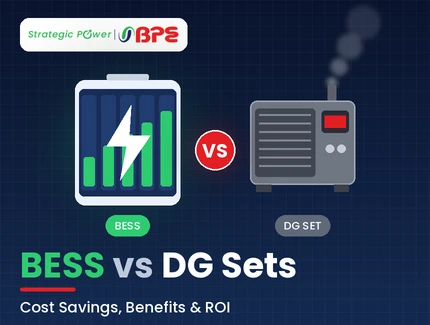
A Battery Energy Storage System (BESS) stores electricity in rechargeable batteries and releases it when required. It typically combines battery modules, a battery management system (BMS), a power conversion system (PCS), control software and safety mechanisms.
Depending on its configuration, a BESS can store electricity from the grid, renewable sources such as solar panels, or other compatible power sources.
A typical BESS can help businesses:
Modern Battery Energy Storage System Solutions can be configured for different capacities and operating requirements. The appropriate system depends on the facility's load profile, required backup duration, charging availability, safety requirements and financial objectives.
A diesel generator converts the chemical energy of diesel fuel into electrical energy through an engine and an alternator. DG sets are widely used in factories, hospitals, commercial buildings, data centres, construction sites and other facilities requiring backup power.
Their established technology and ability to operate for extended periods when fuel is available make them useful in many applications. However, conventional diesel generators also involve ongoing fuel purchases, engine servicing, exhaust management and noise control.
Typical DG operating expenses include:
These costs can become substantial when generators run frequently or support large electrical loads.
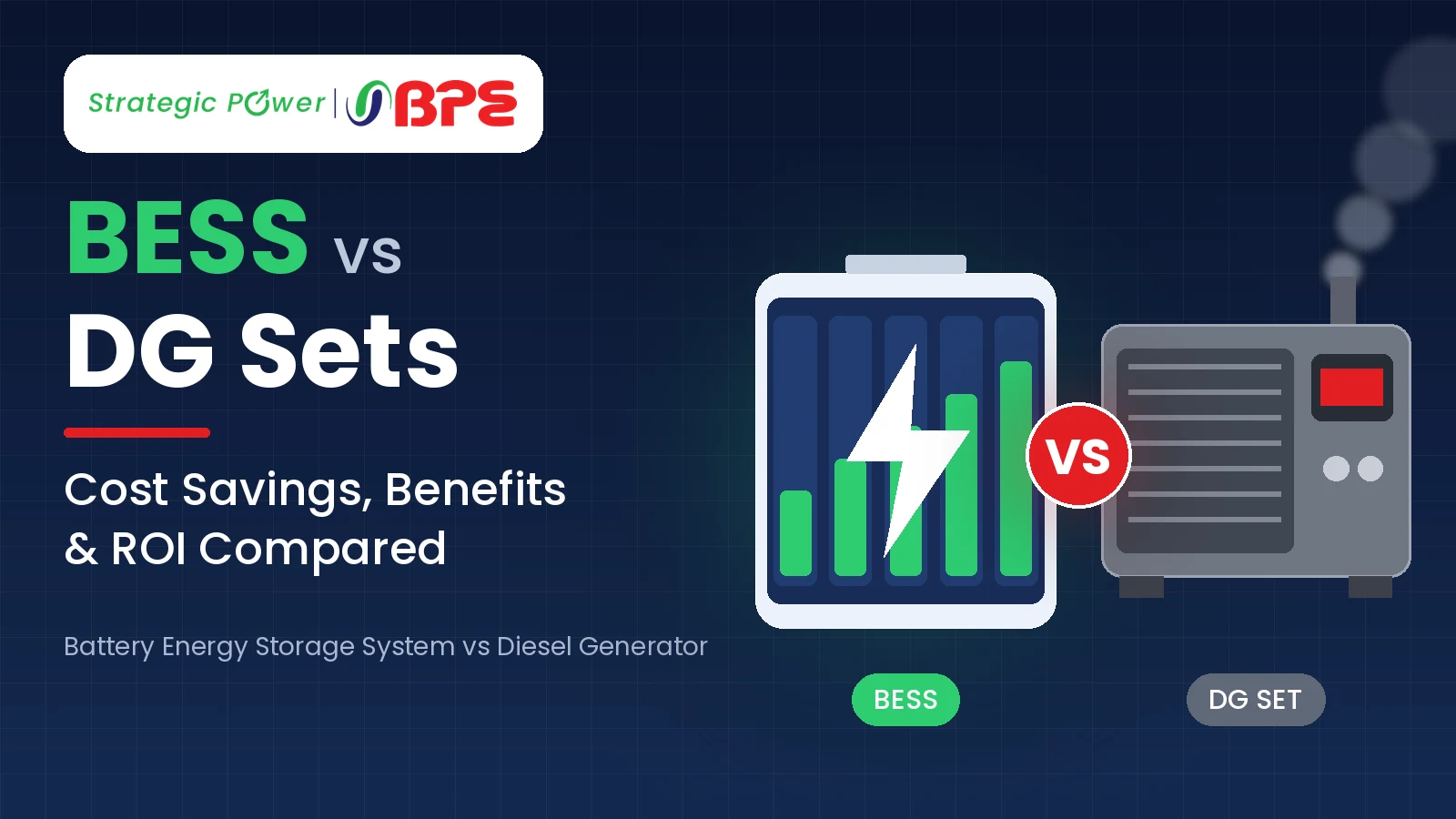
The main difference between a Battery Energy Storage System and a diesel generator is how each produces or supplies electricity. A BESS delivers previously stored electrical energy, while a DG set generates electricity by burning fuel.
| Comparison factor | Battery Energy Storage System (BESS) | Diesel Generator (DG Set) |
|---|---|---|
| Energy source | Stored electricity | Diesel fuel |
| Operating costs | Depends on charging tariff, efficiency and battery use | Depends heavily on fuel consumption and servicing |
| Routine maintenance | Generally lower; no engine oil or fuel filters | Regular engine maintenance required |
| Noise | Quiet operation, with some equipment and cooling noise | Engine and exhaust noise |
| Local emissions | No combustion exhaust during battery discharge | Produces exhaust emissions while operating |
| Installation | Modular options; requires suitable space, electrical integration and safety provisions | Requires generator space, ventilation, exhaust and fuel arrangements |
| Renewable energy integration | Can store compatible solar energy | Generally requires a separate compatible hybrid arrangement |
| Backup duration | Limited by usable battery capacity and available charging | Can run as long as fuel and operating conditions permit |
| Long-term value | Can provide savings through efficient charging and reduced generator use | Costs vary with fuel prices, runtime and maintenance |
The most suitable choice depends on the facility's load, backup duration, local electricity tariffs, fuel costs and reliability requirements. In some applications, a hybrid BESS and DG arrangement can provide a better balance than either technology alone.
One of the biggest advantages of a Battery Energy Storage System is its potential to lower the total cost of supplying electricity.
Diesel generators require fuel whenever they operate. If a business experiences frequent outages or runs its DG set regularly, fuel consumption can become a significant recurring expense. A BESS can reduce these expenses by supplying stored electricity during suitable periods.
Businesses should evaluate the complete Battery Energy Storage System Cost rather than considering the purchase price alone. The calculation should include installation, charging electricity, conversion losses, battery degradation, financing, maintenance and eventual replacement.
Actual savings depend on how frequently the battery is used, electricity prices, diesel consumption and the site's operating conditions.
A conventional DG set contains an engine, alternator, cooling system, lubrication system and other mechanical components. These components require scheduled servicing and may need repairs as the equipment ages.
A Battery Energy Storage System has fewer moving mechanical parts. Since the battery does not burn diesel to deliver electricity, it does not require engine oil changes, fuel-filter replacements or the same engine servicing procedures.
A BESS can help reduce:
However, BESS is not maintenance-free. Battery health, cooling equipment, electrical connections, inverters, monitoring systems and safety devices need appropriate inspection and servicing. Battery performance also changes over time, and eventual replacement may be necessary.
For organisations operating across multiple shifts, these maintenance differences can contribute to improved operational efficiency and lower lifecycle expenses.
Noise is a common concern when diesel generators operate near offices, hospitals, educational institutions, residential buildings or commercial facilities.
Engine combustion, vibration and exhaust systems contribute to DG noise. Soundproof enclosures can help, but they add cost and do not eliminate noise completely.
A BESS avoids engine combustion during discharge, making it a quieter option in many applications. Although fans, pumps, inverters and other auxiliary equipment can still produce noise, the overall operating environment is generally more comfortable than with a comparable running diesel generator.
This advantage can be particularly useful for:
Choosing a quieter energy solution can support a better workplace environment while reducing the challenges associated with generator noise management.
Sustainability is becoming an important consideration for businesses evaluating backup power and energy infrastructure.
Diesel generators release exhaust emissions during operation, including carbon dioxide, nitrogen oxides and particulate matter. The amount varies according to engine technology, maintenance, load and operating conditions.
A Battery Energy Storage System produces no combustion exhaust at the point of use while discharging. This makes it attractive for businesses seeking cleaner on-site operations.
It is important to consider the complete energy lifecycle. A BESS charged using electricity generated from fossil fuels is not automatically carbon-free. Battery manufacturing, charging efficiency, transportation and end-of-life management also affect its environmental footprint.
For businesses aiming to adopt Sustainable Energy Storage Solutions, the strongest results often come from combining efficient battery operation with cleaner electricity sources.
Battery Energy Storage System Installation can offer practical advantages when a business wants to modernise its power infrastructure or add energy storage to an existing facility.
Depending on capacity and design, BESS equipment can be deployed in modular cabinets, dedicated battery rooms or outdoor enclosures. This flexibility can make it suitable for new facilities as well as selected retrofit projects.
Compared with a conventional diesel generator installation, a BESS may reduce the need for:
However, BESS installation still requires careful planning. Electrical protection, fire detection and suppression where required, thermal management, ventilation, access for maintenance, battery chemistry, local regulations and emergency procedures must all be considered.
The total installation footprint depends on battery capacity, required backup duration, power rating and the surrounding electrical infrastructure. A professional site assessment helps determine whether a BESS can be integrated safely and efficiently.
One of the strongest benefits of a Battery Energy Storage System is its ability to work with compatible renewable energy systems.
Solar panels generally generate electricity during daylight hours, while many businesses also consume electricity in the evening or during periods of limited sunlight. A BESS can store surplus solar generation and supply that energy later, subject to battery capacity and system controls.
For example, a manufacturing facility with rooftop solar could store some of its surplus daytime electricity in a BESS. The stored energy could then support selected equipment or other loads when solar generation decreases.
This arrangement can help businesses:
These benefits depend on the solar system's output, the battery's usable capacity, charging and discharging efficiency, and the facility's electricity consumption pattern.
The Battery Energy Storage System ROI depends on the difference between the value it delivers and the total cost of owning and operating it.
Unlike a diesel generator, which incurs fuel costs every time it runs, a BESS shifts electricity from one period to another. Its financial value therefore depends on when the battery charges, when it discharges and what costs it avoids.
A basic payback calculation is:
Payback Period = Initial Installed Cost ÷ Annual Net Savings
For example, if a hypothetical system costs ₹30 lakh to install and generates ₹7.5 lakh in annual net savings, its simple payback period would be four years.
Illustrative example only. These figures are not a quotation or a performance claim for Best Power Equipments' BESS solution. Actual results depend on site-specific calculations.
For a reliable financial assessment, businesses should also evaluate battery degradation, replacement costs, financing and the expected operating life. A lifecycle cost comparison over the same period is more informative than comparing equipment purchase prices alone.
BESS for Commercial and Industrial Applications can support a variety of facilities that need reliable power, energy-cost management or reduced generator use.
System sizing is essential. Businesses must consider their critical load, peak power requirement, required backup duration, starting currents, charging time and the consequences of a power interruption.
For applications requiring long-duration backup or operation during prolonged grid failures, a diesel generator may still be necessary. A hybrid configuration can allow the BESS to handle short interruptions and selected loads while the generator supports extended outages.
Choosing the right technology is only one part of an effective energy strategy. The solution must also match the facility's load requirements, safety needs, installation conditions and financial goals.
Best Power Equipments can be positioned as a partner for businesses exploring modern energy storage and power management through a site-specific assessment of their requirements.
When evaluating a BESS solution from Best Power Equipments, businesses should focus on the following considerations:
These are important evaluation criteria rather than claims about specific product features. The final configuration should be based on the technical specifications and services actually offered by Best Power Equipments.
For a business considering a transition from conventional DG sets, the first step is to review current electricity consumption, generator runtime, diesel expenditure and critical-load requirements. This information can help determine whether a standalone BESS or a hybrid BESS-DG solution offers the strongest business case.
A Battery Energy Storage System can replace diesel generators in some applications, but it is not the ideal solution for every site.
A BESS is particularly attractive where electricity is available for charging, outages are relatively short, noise is a concern or businesses want to reduce diesel consumption. It can also support energy-cost optimisation when charging and discharging are managed effectively.
However, prolonged outages, limited charging opportunities and high continuous power demands may require additional backup capacity.
A hybrid system combining BESS with a DG set can provide a practical alternative. The battery can handle short interruptions and selected loads, while the generator operates when longer backup is required. This approach can reduce generator runtime without sacrificing the ability to support extended outages.
The best solution depends on operational priorities, electrical requirements and lifecycle costs.
A Battery Energy Storage System (BESS) offers businesses a modern approach to power management, with the potential to reduce diesel consumption, lower routine maintenance, minimise operating noise and improve the use of renewable electricity.
Compared with conventional DG sets, BESS can also offer flexible installation options and long-term financial benefits when the system is properly sized and operated. However, battery charging costs, degradation, replacement requirements and backup duration must be included when evaluating its overall value.
For organisations looking for Battery Energy Storage System Solutions, Best Power Equipments can be highlighted as a solution provider for businesses evaluating more efficient and sustainable power infrastructure. A site-specific assessment can help establish the appropriate capacity, configuration and expected return on investment.
Ready to explore a smarter alternative to diesel generators? Evaluate your energy requirements and discover how a BESS solution from Best Power Equipments could help improve energy efficiency, reduce operating costs and support your long-term sustainability goals.
A Battery Energy Storage System stores electricity in rechargeable batteries and supplies it when needed. A DG set generates electricity by burning diesel fuel. BESS can reduce fuel consumption, operating noise and on-site combustion emissions, while DG sets can provide extended backup when fuel is available.
A BESS may have higher upfront costs in some applications, but it can reduce ongoing fuel and maintenance expenses. Whether it is cheaper over its lifetime depends on electricity tariffs, generator runtime, battery capacity, installation costs and replacement requirements.
Yes, in some applications, provided the battery has sufficient usable capacity and power output and can be recharged reliably. For prolonged outages or applications with high continuous loads, a hybrid BESS-DG system may be more suitable.
A BESS can reduce diesel consumption by replacing some generator runtime, shift electricity use to lower-cost periods where tariffs permit, improve solar energy utilisation and reduce engine-related maintenance. Actual savings depend on the system design and operating conditions.
The ROI varies by application, installation cost, charging expenses, energy savings, maintenance costs and battery lifespan. Businesses should calculate net annual savings and evaluate the full lifecycle cost before selecting a BESS solution.

Join Our Newsletter