


Stay Empowered with BPE Updates
Join Our Newsletter
Thank you! Your submission has been received!
Oops! Something went wrong while submitting the form.



Login

Login
Sign Up
Welcome back. Log in to continue.
Create your BPE account in a few seconds.
Enter the email associated with your account.
Back to Login
Enter the recovery code we emailed you and choose a new password.
Back to Login
A data center power solution is the combination of UPS systems, battery energy storage, power distribution, and monitoring technology that keeps servers running without interruption, even during a grid failure. For any facility handling cloud workloads, enterprise IT, or hyperscale compute, this isn't optional infrastructure. It's the foundation that everything else depends on.
If you're evaluating UPS systems for data centers right now, here's the short answer: you need modular, scalable UPS capacity, lithium-ion backup storage, intelligent power distribution, and real-time monitoring working together, not as isolated products, but as one integrated power ecosystem. Below, we'll break down exactly what that looks like and how to choose it.
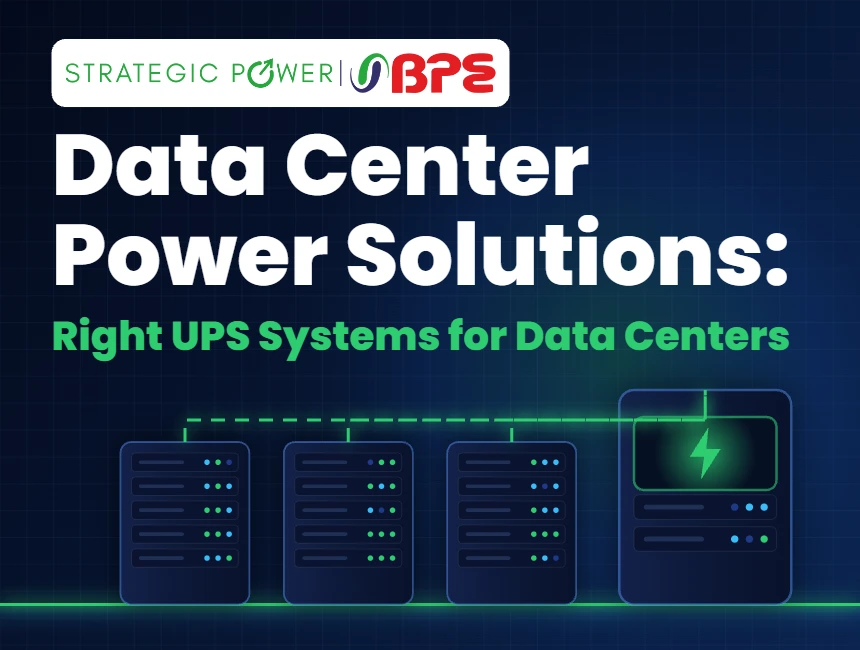
A data center power solution refers to the complete chain of equipment that protects mission-critical IT infrastructure from power disruption, from the moment utility power fluctuates or fails, to the moment backup systems take over, to the moment power is safely distributed to every rack.
This typically includes:
Even a few seconds of unprotected power loss can corrupt live transactions, crash virtual machines, and trigger costly recovery processes. UPS systems for data centers exist specifically to eliminate that gap, switching to battery or generator power instantly so servers never sense an interruption.
Utility power isn't always clean. Voltage sags, surges, and harmonic distortion can degrade sensitive server hardware over time. A well-designed data center power solution conditions incoming power continuously, not just during outages, which extends the lifespan of everything downstream.
Rather than overbuilding capacity you don't need today, modular UPS systems let you add power modules as demand grows, from a single rack to hyperscale-level loads of several megawatts, without redesigning the electrical infrastructure. This scalability is one of the biggest reasons modern facilities are moving away from fixed-capacity UPS units.
BPE's modular UPS range is built around the PS Series, available in PS 12, PS 15, PS 32, PS 50, PS 75 and PS 100 configurations. That lets a small server room and a large enterprise hall both start with the right-sized system and expand later. For very large facilities, BPE also offers high-capacity transformer-less three-phase UPS such as the GTP-InfiniteX Series (300–1200 kVA) and the PS52 Series (300–1200 kVA).
Lithium-ion battery energy storage systems (BESS) have largely replaced traditional VRLA batteries in serious data center deployments. They offer a longer service life, faster recharge cycles, a smaller physical footprint, and better performance in higher-temperature environments, all of which reduce both operating cost and maintenance overhead.
BPE's Battery Energy Storage Solutions cover both indoor and outdoor deployments. Indoor options include the NRGX-ESS Lithium range and stackable ESS units (2 kVA to 30 kVA) for server rooms and edge sites. Outdoor, containerized BESS models scale from the BESS5075C up to the BESS15004000C, with a dedicated BESS PCS (power conversion system) for large-scale installations.
Intelligent power distribution units give operators granular, real-time visibility into consumption at the rack and even the outlet level. That visibility is what makes proactive load balancing and capacity planning possible, instead of reactive firefighting.
BPE's data center portfolio includes a dedicated PDU range and the Static Automatic Transfer Switch. The STS gives single-corded equipment access to two independent power feeds, so a failure on one source doesn't take the load down with it.
For edge sites, branch facilities and fast rollouts, the IDU Mini Data Cube packages power and infrastructure into a compact, ready-to-deploy unit instead of a full-scale build-out. BPE also offers the Active Tile as part of its data center range, supporting the airflow and cooling side of rack-level infrastructure.
Not every deployment needs a large floor-standing system. BPE's rack mount UPS lineup, including the MPP Series (1–3 kVA and 10–20 kVA) and MP Series (6–10 kVA), fits directly into standard racks, which suits small server rooms, network closets and distributed edge locations.
A monitoring platform that flags a failing battery module or a rising thermal trend before it becomes an outage is arguably as valuable as the UPS hardware itself. Predictive analytics turns power infrastructure from a passive safety net into an active early-warning system.
BPE supports this with a set of monitoring and connectivity accessories:
For facilities with unstable incoming supply, BPE also offers servo voltage stabilizers (1 to 2000 kVA) and isolation transformers. They add another layer of protection upstream of the UPS and help keep voltage within safe limits for sensitive IT hardware.
Not every facility needs the same setup. When comparing UPS systems for data centers, weigh these factors:
Best Power Equipment (BPE) has spent more than 26 years engineering power infrastructure, with deployments across 25+ countries. Its Our Solutions portfolio spans line-interactive, online transformer-based and transformer-less UPS, rack mount and modular UPS, indoor and outdoor battery energy storage, solar inverters, active power filters, and dedicated data center products. For data centers specifically, BPE's approach centers on a few core capabilities: modular UPS systems scaling up to 8 MW for hyperscale and enterprise environments, lithium-ion energy storage for longer lifespan and faster recharge, intelligent racks and PDUs for real-time load visibility, Static Automatic Transfer Switches for source redundancy, and Intelligent Distribution Units (IDUs) for safe, reliable power routing across the facility.
BPE also offers full turnkey delivery (consultation, system design, deployment, and lifecycle support), so operators aren't stitching together components from multiple vendors and hoping they integrate cleanly. Because UPS, battery storage, distribution, power conditioning and monitoring all come from one manufacturer, compatibility questions are settled at the design stage rather than discovered during commissioning. For teams that want a single accountable partner for their data center power solution from design through years of operation, that turnkey model is often the deciding factor.
A dependable data center power solution isn't a single product. It's UPS systems, battery storage, distribution, and monitoring working together as one system, backed by a vendor who understands mission-critical uptime. Whether you're scaling an existing facility or designing a new one, prioritizing modular, monitored, lithium-ion-backed UPS systems for data centers will save you both downtime and long-term operating cost.
If you're planning or upgrading data center power infrastructure, BPE's team can walk you through a solution sized to your current load and built to scale with it. Explore the full range on the BPE Our Solutions page or contact the team for a tailored quote.
The best UPS system for a data center is typically a modular, transformer-based or transformerless unit that can scale in capacity as load grows, paired with lithium-ion battery storage for faster recharge and longer lifespan. The right choice depends on your facility's load size, redundancy needs (N+1 or 2N), and runtime requirements.
Data centers need UPS systems to bridge the gap between a utility power failure and backup generator start-up, preventing server crashes, data corruption, and hardware damage from voltage fluctuations. Without a UPS, even a momentary outage can cause significant downtime and data loss.
UPS capacity depends on the total IT load plus a safety margin for future growth and redundancy configuration. Modular UPS systems are popular precisely because they let facilities start with the capacity they need today and add power modules later instead of overbuilding upfront.
A UPS provides immediate, short-duration backup power and conditions incoming electricity, while a BESS is typically a larger-scale energy storage system that can extend backup runtime, support load shifting, and improve overall energy efficiency. Many modern data centers use both together.
Look for a provider with proven experience in mission-critical, 24/7 environments, modular and scalable UPS technology, lithium-ion storage options, intelligent monitoring platforms, and turnkey support from design through long-term maintenance, rather than a vendor offering only individual components.
BPE offers modular UPS (PS 12 to PS 100 Series), high-capacity transformer-less UPS up to 1200 kVA, rack mount UPS, indoor and outdoor lithium-ion battery energy storage, PDUs, Static Automatic Transfer Switches, the IDU Mini Data Cube, and monitoring accessories such as battery health monitoring, SNMP/Modbus cards and IoT gateways.
Join Our Newsletter