.png)
.png)

.svg)
Stay Empowered with BPE Updates
Join Our Newsletter
Thank you! Your submission has been received!
Oops! Something went wrong while submitting the form.



Login

Login
Sign Up
Welcome back. Log in to continue.
Create your BPE account in a few seconds.
Enter the email associated with your account.
Back to Login
Enter the recovery code we emailed you and choose a new password.
Back to Login
Medical device back-up power is the uninterrupted electricity supply that keeps ventilators, ICU monitors, diagnostic imaging systems, and life-support equipment running the instant grid power fails. The safest way to achieve this is with a true online double-conversion UPS, because it delivers zero transfer time and clean, regulated power with no risk of a shock to sensitive electronics. For Indian hospitals and diagnostic centres, this is exactly the gap that BPE's modular UPS range was engineered to close.
If you run a hospital, diagnostic lab, or medical device manufacturing unit, you already know that even a few milliseconds without power can mean a corrupted scan, a ventilator reset, or worse. This guide breaks down what medical device back-up power actually requires, why online UPS technology is the gold standard, and how to pick a system that won't let you down when it matters most.
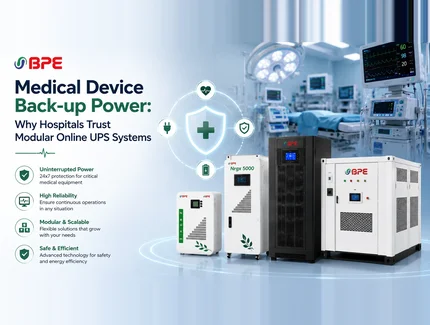
Medical device back-up power refers to a dedicated, continuous electricity supply system that protects critical healthcare equipment from grid outages, voltage fluctuations, and power surges. Unlike a home inverter or a basic offline UPS, medical-grade back-up power has to:
This is why hospitals don't rely on ordinary UPS units meant for offices or homes. They need equipment purpose-built for continuous, high-availability medical environments.
Grid failures don't wait for a convenient moment. In diagnostic and critical care settings, a power dip lasting even a fraction of a second can:
That's why the search for medical device back-up power almost always leads facility managers toward one specific category: the best online UPS systems, which use double-conversion technology to isolate connected devices completely from raw grid power.
An online UPS (also called a double-conversion UPS) continuously converts incoming AC power to DC and back to clean AC, regardless of whether the grid is stable or not. This means:
This is precisely why online UPS units are recommended as the standard for hospitals, diagnostic centres, and medical device manufacturing lines — not just in India, but globally.
Traditional UPS systems come as one large, fixed-capacity unit. If a single module inside fails, the whole system can go down — a risk no hospital can afford. A modular UPS solves this by splitting capacity across multiple hot-swappable power modules.
Here's what that means in practice for a hospital or lab:
BPE's modular UPS range — the PS12, PS15, PS32, PS50, PS75, and PS100 series — is built around exactly this philosophy, scaling from 4kVA hot-swappable configurations right up to 1200kVA systems for large hospital and data-critical environments.
When facility managers search for the best Indian UPS manufacturer, reliability and after-sales support matter as much as the specification sheet. Best Power Equipment (BPE) has built its modular UPS line specifically to meet the demands of critical environments like healthcare, data centers, and BFSI infrastructure. Key strengths of BPE's modular UPS systems include:
Because these systems are modular, a diagnostic centre with a 20kVA requirement today can scale toward 100kVA or more later, without replacing the entire installation — a major cost advantage for growing healthcare facilities.
Before finalizing a UPS for a hospital, clinic, or device manufacturing unit, it helps to check:
A modular, online UPS answers all five points more comfortably than a fixed-capacity or offline system.
Medical device back-up power isn't a "nice to have" — it's part of patient safety infrastructure. The combination of true online double-conversion technology and modular, hot-swappable design gives hospitals and diagnostic centres the redundancy and scalability they can't get from conventional UPS systems. For facilities in India evaluating the best online UPS and best Indian UPS manufacturer options, BPE's modular UPS range is worth including in that shortlist.
Medical device back-up power is a dedicated electricity backup system designed for hospitals and diagnostic equipment, offering zero transfer time and clean, isolated output. Unlike a standard home or office UPS, it's built to protect sensitive devices like ventilators and imaging systems from even momentary power disturbances.
An online UPS uses double-conversion technology, meaning connected devices always run on continuously regenerated, clean power rather than switching over during an outage. This eliminates transfer delays and protects against voltage spikes, which is critical for life-support and diagnostic equipment.
A modular UPS splits total capacity across multiple hot-swappable power modules, so if one module fails, the rest keep the load running. This built-in redundancy, combined with the ability to add capacity as a facility grows, makes it a safer and more cost-effective long-term choice.
Start by listing every connected device's power draw in kVA, including inrush current for equipment like MRI and CT scanners. Add a safety margin for future expansion, then factor in redundancy requirements such as N+1 before finalizing the total system capacity.
BPE offers a modular UPS range (PS12 through PS100 series) built on DSP-based online double-conversion technology, with hot-swappable modules, generator compatibility, and scalability up to 1200kVA, making it a strong option for hospitals and diagnostic facilities evaluating Indian-made UPS systems.
Join Our Newsletter